
Picture a project manager standing at a crowded airport boarding gate, balancing a carry-on bag while urgently trying to modify a complex vendor agreement on her iPhone 14 Pro. The internet connection is unreliable, the flight is boarding, and the document is eighty pages long. In moments like this, theoretical technology means nothing; practical utility means everything. NeuralApps is a software development company specializing in AI-powered mobile solutions that translate advanced algorithmic potential into immediate, practical digital workflows for everyday users. Our mission is to build mobile environments where artificial intelligence operates invisibly in the background, resolving friction before the user even recognizes it exists.
As a product designer focused on mobile applications and user experience, my daily work involves bridging the massive gap between what a neural network can process and what a human being actually needs to see. We do not build technology for the sake of novelty. We build innovative digital experiences designed to accelerate human decision-making, whether someone is running a field sales team from their pocket or managing critical documentation on the go.
Real-world utility drives the adoption of mobile AI
The conversation around machine learning often focuses on massive cloud infrastructure and enterprise-scale data processing. However, the most profound impact happens at the edge—right in the palm of the user's hand. When we map out our product roadmap at NeuralApps, we start by looking at where traditional applications fail. A conventional app asks the user to do the heavy lifting: search through menus, manually input data, or scroll through endless text. An intelligent application anticipates the intent and does the heavy lifting itself.
The business mandate for this shift is overwhelming. According to a recent 2026 comprehensive analysis published by National University on AI statistics and trends, 83% of companies report that utilizing AI in their business strategies is a top priority, and 60% of business owners believe it will directly increase their productivity. Even more telling is that 97% of business owners explicitly think using tools like conversational agents will help their business. People are ready for intelligent systems, but they lack the localized, mobile-first tools to execute these strategies effectively outside of desktop environments.
This is exactly the gap we target. A user should not have to be tied to a high-powered workstation to benefit from semantic search or automated data extraction. By focusing on mobile platforms, we are putting enterprise-grade computing power into the pockets of the workforce.

Designing intelligence means hiding the complexity
One of the most challenging aspects of my role is ensuring that the interface remains incredibly simple while the underlying architecture grows increasingly complex. The neural network software market is witnessing robust growth, expanding from $41.37 billion in 2025 to a projected $52.25 billion in 2026, according to recent data from ResearchAndMarkets.com published via GlobeNewswire. As this technology matures, the temptation for developers is to expose all these new capabilities to the user, resulting in cluttered interfaces and overwhelming configuration screens.
Our product philosophy explicitly rejects this approach. Consider how we approach our mobile PDF editor. A standard document application requires the user to manually highlight text, add annotations, and type out summaries. By integrating localized language models directly into the mobile application, we allow the software to instantly generate a bulleted summary of a legal contract or automatically flag inconsistent clauses. The user does not need to understand natural language processing or prompt engineering; they simply tap a button that says "Summarize." The complexity is entirely abstracted away. For a deep technical perspective on how we achieve this performance on mobile hardware, my colleague Umut Bayrak detailed our methodology in his guide on how to deploy task-specific AI in mobile environments.
Hardware fragmentation demands scalable software solutions
Building for mobile means designing for a fragmented reality. While it is exciting to design for the latest A16 Bionic chip in an iPhone 14 or the extended battery capabilities of an iPhone 14 Plus, we must also account for users running our applications on older hardware like an iPhone 11. An AI powered mobile solution is only truly valuable if it degrades gracefully across different generations of hardware.
This requires a hybrid approach to development. Heavy processing tasks that require massive compute power can be offloaded to secure cloud servers, while privacy-centric or latency-sensitive operations are handled locally on the device's neural engine. For instance, biometric authentication and basic document scanning happen instantly on the device, ensuring the user is never waiting on a server response. More intensive tasks, such as cross-referencing a massive enterprise database, are routed efficiently to the cloud.
When we evaluate which user problems to tackle next, hardware constraints play a significant role. As Furkan Işık explored in his analysis of which app categories solve real user problems best, forcing an intelligent feature into a category that doesn't natively benefit from it—or designing a feature that drains a battery in twenty minutes—is a failure of product design. True utility respects the medium it lives on.
Market momentum requires practical execution over theoretical promises
We are currently operating in a transitional phase of digital adoption. In 2023, Eurostat noted that 59% of EU companies had reached basic digital integration. This means over half the market has moved beyond paper ledgers and analog systems, but they are now hitting the ceiling of what traditional software can offer. They are ready for the next layer of efficiency.
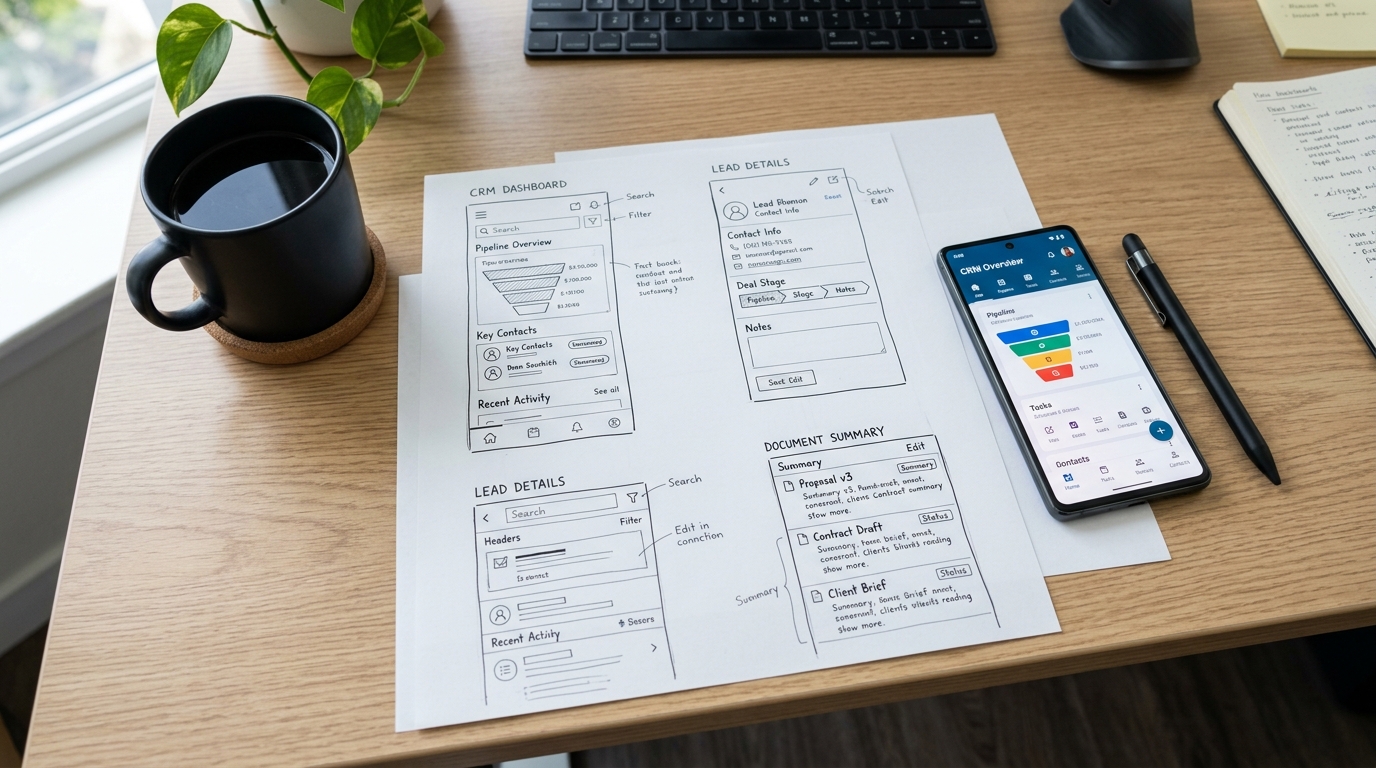
At NeuralApps, our response to this market maturity is to focus on systems that actively manage workflows rather than just passively storing data. Take the traditional CRM application. Historically, a mobile CRM is just a glorified address book. Sales professionals hate using them because they require constant manual data entry after every client meeting. It is a system that demands time rather than saving it.
By applying intelligent automation, we flip this dynamic. Our development focus shifts to building solutions that can passively transcribe a voice memo after a meeting, automatically extract the action items, and populate the CRM fields without manual typing. The application becomes an active participant in the workflow. This is the difference between an application you have to use and an application you want to use.
Agentic capabilities represent the next phase of mobile productivity
Looking at the near future, the static application model is being replaced by autonomous systems. According to Fortune Business Insights, the global machine learning market size is expected to reach $309.68 billion by 2032. Within that massive expansion, SoftTeco highlights a crucial sub-trend: agentic AI. Unlike traditional systems that wait for a human input, agentic systems can understand context, plan, and execute multi-step tasks independently.
From a design perspective, this fundamentally changes how we structure our software development processes. Instead of designing a linear flow of screens, we are designing conversational parameters and permission boundaries. If a user receives a time-sensitive email with a contract attachment, the mobile operating system of the future won't just send a push notification. The embedded intelligence will review the contract, compare it to the company's standard terms, highlight the discrepancies, and present the user with a draft email response.
Our current portfolio acts as the foundational stepping stones toward this reality. By familiarizing users with highly capable, single-purpose intelligent tools today, we are building the trust required for the autonomous agents of tomorrow. Trust is the ultimate currency in software design. If a user cannot trust an application to accurately crop and format a document, they will never trust it to negotiate a schedule or modify a client database.
Everyday friction dictates our development roadmap
Ultimately, a company is defined not by the technology it claims to understand, but by the specific human problems it chooses to solve. The architecture we build and the interfaces we design all serve a single master: the user's time. When we reduce the time it takes to find critical information, when we eliminate the need to manually re-enter data across multiple platforms, and when we turn complex analytics into clear, actionable insights on a mobile screen, we are fulfilling our core promise.
NeuralApps will continue to pioneer in this space by keeping our focus relentlessly narrow. We do not aim to build artificial general intelligence. We aim to build the fastest, most reliable, and most intuitive professional tools available on mobile platforms. Because when that project manager is standing at the boarding gate with her flight calling final boarding, she doesn't care about the size of the neural network running in the cloud. She just needs the application to work.