 NEURAL APPS
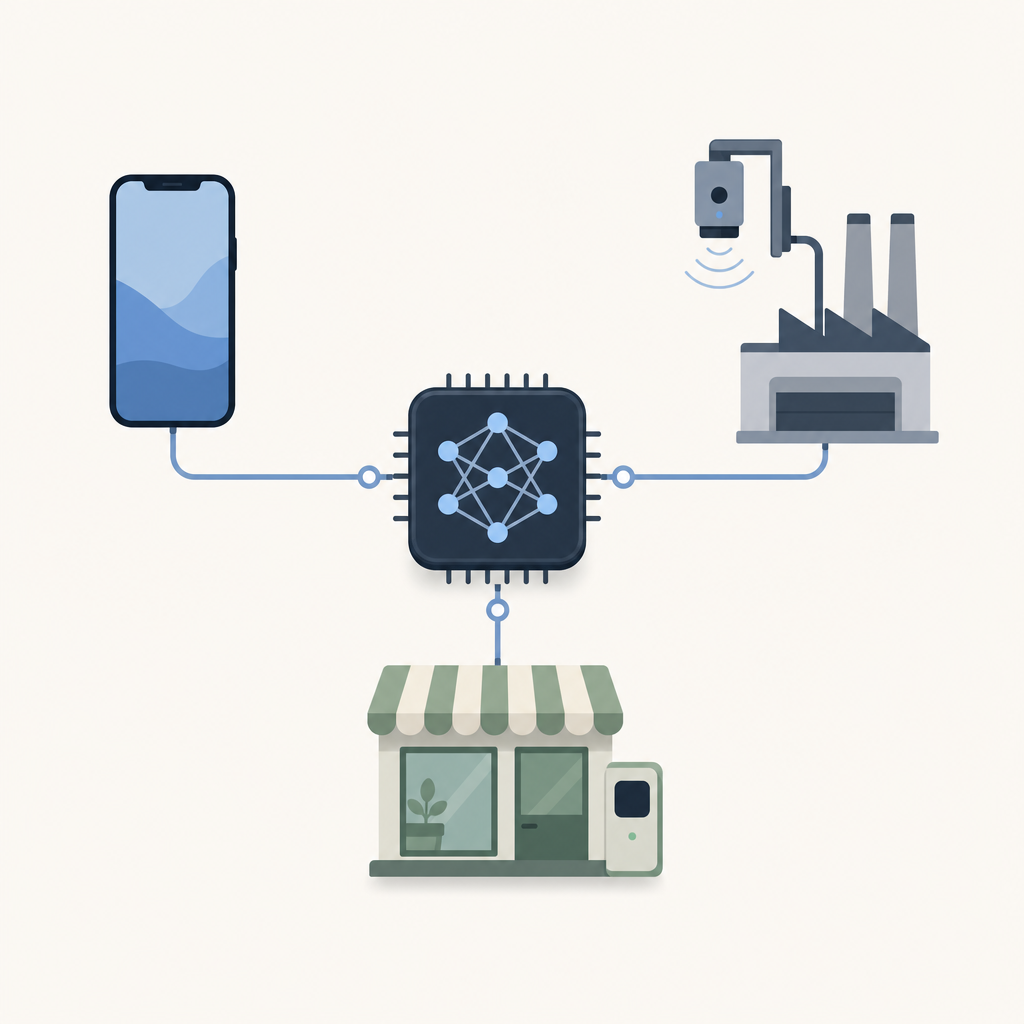
Edge AI is the practical choice when an AI product needs fast local decisions, less raw-data movement, or reliable behavior when the network is weak. For a business choosing between cloud inference and on-device AI, the first question is where the decision must happen: near the user, near the sensor, or on a remote server.
A cloud model can inspect loading-dock images if bandwidth is cheap and delay does not matter. If the system must flag a damaged label before the box leaves the belt, the model needs to run close to the camera, with only exceptions and summaries sent back later.
What is edge AI in plain terms?
Short answer: Edge AI means running an AI model close to where data is created, such as on a phone, laptop, camera, sensor, vehicle, or local gateway. The device performs at least some inference locally instead of sending every input to a remote server.
A mobile app that recognizes a document type before upload is using this pattern. So is a factory sensor that listens for abnormal vibration and raises a local alert instead of streaming raw audio all day.
On-device AI is a narrower phrase. It usually means the model runs directly on the end user device, while edge AI can also include nearby hardware such as an industrial gateway, point-of-sale terminal, or branch office server.
When does edge AI beat cloud AI?
Short answer: Edge AI beats cloud AI when latency, privacy, offline use, bandwidth, or local control matters more than using the largest possible model. Cloud AI still wins when the product needs heavy reasoning, broad context, or frequent model changes.
The strongest edge use cases are practical. They remove a delay, reduce a transfer, or let a workflow continue when the connection is poor. A checkout camera confirming produce type, a field tablet reading equipment labels, and a security device detecting motion without uploading every frame all share that shape.
- The decision window is short. If the user or machine has already moved on, the model answered too late.
- The input is sensitive. Faces, documents, audio, and workplace footage should be minimized where possible.
- The same task repeats often. A compact specialist model can be enough for one narrow job.
- The environment is unreliable. Vehicles, farms, warehouses, homes, and branch offices do not always have clean connectivity.
- The output is small. Sending an alert, label, embedding, or confidence score is usually cleaner than sending raw media.
Local inference does not remove consent or surveillance obligations. For cameras, face analysis, audio, and workplace footage, check local law and company policy; many jurisdictions can impose notice, consent, retention, access, biometric, audio, or employee-monitoring duties even when raw media stays on the device.
The catch: local inference is not free. Someone still has to size the model, test it on real hardware, ship updates, and decide what happens when the model is unsure.
What consumer app shows edge AI in practice?
Practical answer: Google Pixel Recorder is a useful consumer example. Google Pixel Help documents real-time transcription language support by Pixel generation and says recordings are available only on the Pixel phone or Pixel Tablet unless the user backs them up, shares, copies, or saves them elsewhere. It also notes that re-transcribing may process audio files on Google servers. The product lesson is hybrid: disclose what stays local, what may leave the device, and which user action changes that path. Source: Google Pixel Help on Recorder transcriptions and Google Pixel Help on sharing recordings, checked June 3, 2026.
How we checked: We reviewed official vendor help pages and kept the takeaway limited to them. We did not inspect app code, network traffic, or every Pixel model, so teams should verify current device support, settings, permissions, and law for their release.
How should a team compare edge AI vs cloud AI?
Short answer: Compare edge AI vs cloud AI by the decision point, not by model popularity. If the product value depends on immediate, private, local action, edge inference deserves a pilot; if it depends on deep context and fast iteration, cloud inference may be the cleaner first build.
Use the table as a product review. Score the real workflow, then look for the pattern.
| Criterion | Edge AI is favored when | Cloud AI is favored when | Question to ask |
|---|---|---|---|
| Latency | The action must happen before the user or machine moves on. | A short wait is acceptable. | What breaks if the answer arrives late? |
| Privacy | Raw input should stay local or be reduced before syncing. | Central processing is allowed with clear controls. | What is the smallest payload we can send? |
| Connectivity | The product must work in weak or costly networks. | The workflow assumes a stable connection. | What happens during an outage? |
| Operations | Hardware is controlled, testable, and updatable. | Central deployment speed matters more. | Who owns model updates on devices? |
A demo on a fast laptop does not prove field readiness. Edge deployments have to survive old phones, different camera sensors, hot rooms, weak batteries, and gateways that may not update on schedule.
What does a realistic edge AI pilot look like?
Short answer: A realistic edge AI pilot starts with one narrow decision, one target device class, and one fallback path. Do not move an entire cloud pipeline to the device; prove that local inference improves one workflow users already care about.
Take a maintenance app that reviews photos from technicians. The cloud can still store cases and run deeper analysis. The edge pilot might only detect whether the photo is usable and warn the technician before they leave.
- Define the local decision. Write one sentence: the device should decide X before Y happens.
- Pick the target hardware. Choose the lowest device tier the product must support, not the nicest test machine.
- Set a baseline. Keep a cloud model or simple rules-based path for comparison.
- Compress carefully. Quantization, pruning, and distillation can shrink models, but each change can hurt edge cases.
- Design the unsure state. Low confidence should trigger review, cloud escalation, or a clearer user prompt.
- Log what matters. Track device class, confidence, fallback rate, and user correction without collecting raw sensitive data by default.
The most useful pilot result may be a no. If the model drains the battery or misses too many cases, keep the task in the cloud or split it into a hybrid flow.
Which neural network applications are strongest at the edge?
Short answer: The strongest neural network applications at the edge are narrow, repetitive, and tied to local sensor data. Vision checks, audio triggers, document pre-processing, equipment monitoring, and lightweight personalization are stronger candidates than broad open-ended reasoning.
Computer vision is an obvious category because cameras generate heavy data and many visual decisions are local. A device can detect an empty shelf, visible badge, or damaged label without uploading continuous video. The model needs one dependable call, not full business understanding.
- Industrial inspection: flag damaged labels, missing parts, blocked lanes, or unsafe positions near the source.
- Voice and audio: run wake-word detection, noise classification, or machine-sound anomaly checks locally.
- Document workflows: detect blur, crop pages, classify forms, or mask fields before upload.
- AI for business apps: rank cached tasks, suggest likely categories, or pre-fill fields while offline.
These use cases work because the model has a bounded job. Edge AI becomes weaker when the request needs long context, constant new knowledge, or many uncertain steps.
Claim: Local or hybrid language-model features are real, but device, language, and feature support vary. Evidence: Apple Support says Apple Intelligence can process some requests on iPhone and use Private Cloud Compute for others; Google Pixel Help says Recorder summaries use a large language model and certain languages may need internet access. Sources checked June 3, 2026. Limit: This is not proof that an app can run unrestricted ChatGPT-style output offline. Action: Publish supported devices, model route, fallback behavior, and regions before calling a feature on-device.
What are the trade-offs of on-device AI?
Short answer: On-device AI trades centralized power for local speed and control. The limits show up in model size, hardware variation, battery use, monitoring, update delivery, and privacy design.
Smaller models can be excellent, but they are not magic. A model that performs well on one phone may run slowly on another. A camera model trained in bright indoor conditions may struggle at night, in glare, or on a dusty lens.
Privacy also needs discipline. Processing a face, document, or voice sample locally can reduce exposure, but the app may still store outputs, send analytics, or sync identifiers. The team has to define what is collected, how long it is kept, who can access it, and how users understand that flow.
Claim: Edge AI can reduce data exposure, but it does not make a product private or compliant by default. Why this matters: A device can process raw input locally, yet the app may still transmit outputs, analytics, identifiers, synced records, or review queues. Limit: Privacy and workplace-monitoring rules vary by jurisdiction, data type, and policy. Action: Document notice, consent, input, output, storage, access, sync, retention, and deletion before launch.
Cost has the same nuance. Edge inference can reduce server calls and bandwidth, but it may add QA, hardware constraints, and support work. Cloud inference is easier to update, but recurring compute and data movement can grow expensive at scale.
Frequently asked questions
Is edge AI the same as on-device AI?
They overlap, but they are not always identical. On-device AI usually means the model runs directly on the user device, such as a phone or laptop. Edge AI is broader and can include nearby hardware, such as a local gateway, camera, vehicle computer, or branch server.
Is edge AI more private than cloud AI?
Edge AI can be more private when raw data stays local and only minimal outputs are sent elsewhere. That is not guaranteed. If the app uploads predictions, identifiers, analytics, recordings, or synced records without a clear reason, the privacy advantage shrinks. Teams still need notice, consent, retention limits, access controls, and deletion paths.
Can edge AI run large language models?
Some language models can run locally when they are small enough for the target device and the task is constrained. A compact local model can help with classification, extraction, or short summaries, while a cloud model may still be better for long context, complex reasoning, and current external knowledge. Treat device, language, model size, and fallback as product requirements.
What is the first step for a business edge AI project?
Write down one local decision that would improve the workflow if it happened immediately. Then choose the lowest device class that must support it, build a baseline, and test whether a compact model gives a better result. If fallback is unclear, fix that before expanding the pilot.